


 Our Services
OUR SERVICES
Partnering with Factories in Sustainable Business
Responsible Business Vietnam provides 3 types of services, including: Assessment, Advisory, and Training. The Core services are designed to support factories not only to meet with international standards, but also to build their internal capacity for sustained improvements.
We believe that an “audit-and-leave” model does not lead to sustained improvements. RBV’s services are designed around continuous accompaniment — from diagnosing current conditions to building lasting management systems.
Our goal is not only to help businesses meet supply chain due diligence requirements, but also to build management systems, foster a culture of dialogue, and strengthen collaborative partnership.
TRAINING
Building awareness and practical capacity, laying the foundation for sustainable improvement
- Deepening understanding of labour rights and workplace responsibilities
- Strengthening management, leadership, and compliance skills
- Promoting a safe, respectful, and inclusive working environment
ADVISORY
Developing sustainable improvement solutions tailored to each factory
- Developing and improving internal policies and procedures
- Strengthening workplace dialogue
- Addressing labour and sustainable compliance challenges
- Meeting the requirements of national law and international buyers
ASSESSMENT
Identifying risks and opportunities for improvement
- Demonstrating compliance with labour law and labour standards
- Reducing legal risk
- Strengthening management capacity and improving operational efficiency
- Building trust with customers and partners
MANAGEMENT SYSTEMS
Building effective and sustainable compliance management systems
- Refining policies and procedures
- Establishing clear lines of responsibility
- Strengthening self-monitoring capacity
- Continuous analysis and improvement
DIALOGUE
Fostering open dialogue and building harmonious labour relations
- Supporting safe and constructive communication mechanisms
- Amplifying worker voice and participation
- Preventing and resolving workplace conflict
PARTNERSHIP
Minimising duplication, scaling impact, and driving sustainable change
- Businesses, industry associations, and international partners
- Regulatory authorities, civil society organisations, and development partners
- Domestic and international initiatives
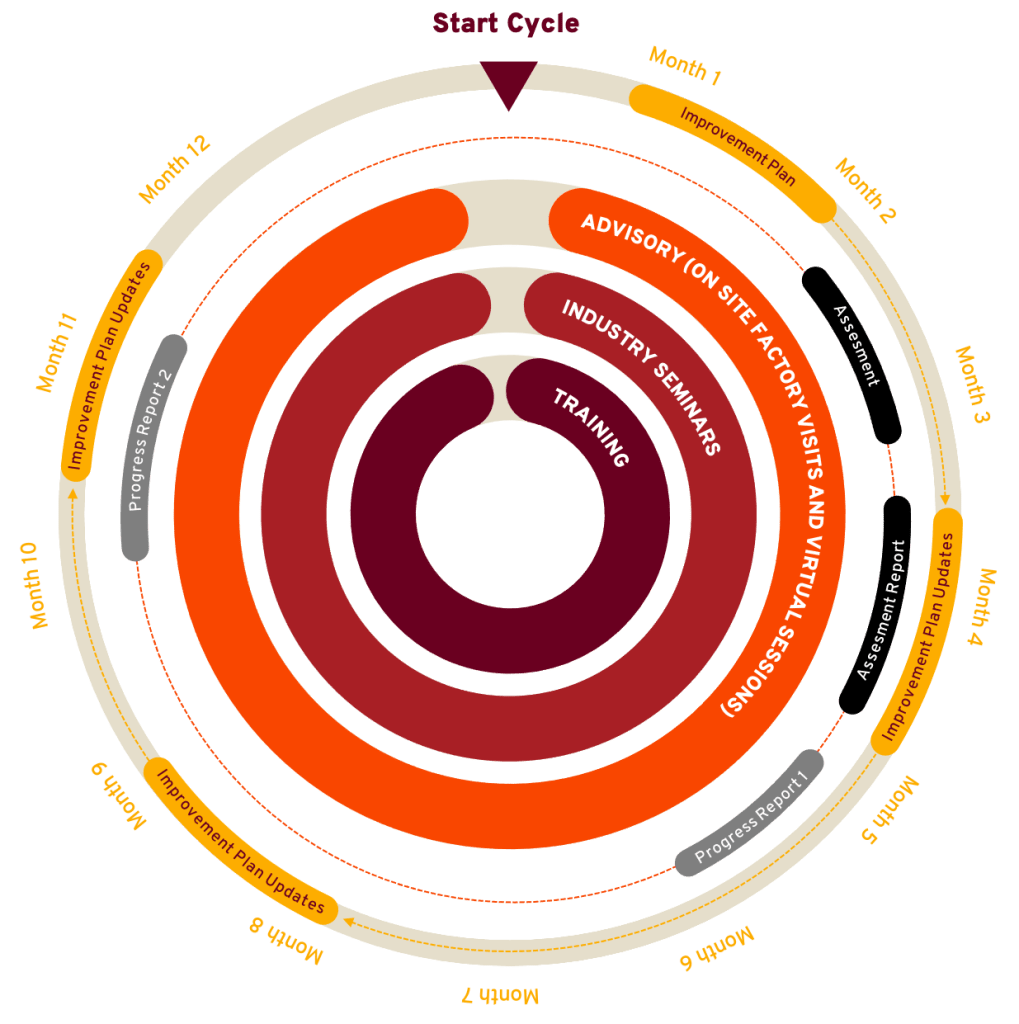
OUR INTEGRATED SERVICE PACKAGE
Assessment
Instead of a traditional “pass” or “fail” inspection, our assessment service functions as an in-depth diagnostic tool. Our experts work on-site at factories to identify strengths and areas for improvement in compliance with national labor laws and international labor standards. More importantly, we help enterprises uncover the root causes of issues to develop comprehensive and sustainable corrective solutions.
Advisory
After the assessment, we continue to accompany and work directly with enterprises to develop and implement improvement plans. Our advisory activities go beyond addressing identified non-compliances — they also foster workplace dialogue, strengthen management systems, build training programs, and enhance capacity for long-term, sustainable improvement. Enterprises are invited to join a community of peers to share experiences, good practices, and receive ongoing guidance and support.
Training
To ensure lasting change, we offer a wide range of training programs designed to equip both management and workers with essential knowledge and skills. These programs cover key topics such as labor law, supervisory management skills, effective communication, occupational safety and health, human resource management, gender equality integration, and many others. Through these trainings, factories are empowered to independently sustain continuous improvement and foster a better working environment.
Drawing on the models, methodologies, and experience of the Better Work Programme, we aim to strengthen business competitiveness and create lasting social value.
Increased productivity
Experience from the Better Work Vietnam Programme shows that training Line Supervisors in management skills can help increase line productivity by 22%.
Higher profitability
In Vietnam, on average, factories participating in the Better Work Programme have a 25% higher revenue-to-cost ratio after four years in the Programme.
More orders
Enterprises that make sustainable improvements in areas such as wages and working hours often receive more orders from brands.
Avoiding duplicate assessments
In Vietnam, brands participating in the Programme commit to using shared Better Work reports and, therefore, enterprises are not assessed multiple times, helping save time and costs.