


- About Decision 843
On 14 July 2023, the Prime Minister of Vietnam issued Decision No. 843/QD-TTg on the “National Action Program to Improve Policies and Laws to Promote Responsible Business Practices in Vietnam for the 2023–2027 period.” The objectives of the Decision are to:
- Raise awareness and capacity on Responsible Business Practices (RBP) for state authorities, enterprises, and the community;
- Review and improve laws and policies in the fields of investment, labor, environment, consumer protection, and protection of vulnerable groups;
- Improve enforcement effectiveness and sanctions, creating a fairer and more sustainable business environment.
Decision 843 also affirms that Vietnam aligns these efforts with the 2030 Agenda and the 17 Sustainable Development Goals (SDGs) of the United Nations, as well as commitments under the EVFTA, CPTPP, and other trade and investment agreements.
- Key Contents of Decision 843
2.1. 2.1. Perspectives and Objectives
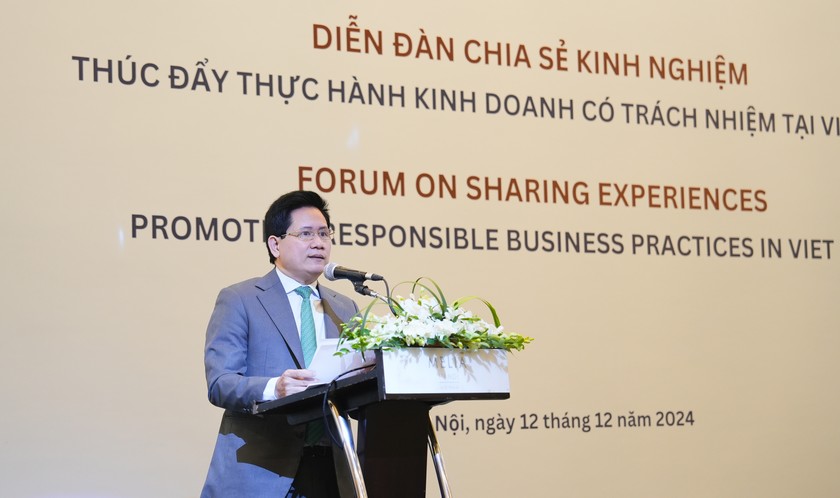
Decision 843 sets out several important orientations:
- Developing a socialist-oriented market economy, international integration, and sustainable and inclusive development;
- Promoting responsible business practices, protecting the lawful rights and interests of workers, consumers, and vulnerable groups;
- Contributing to the development of a circular economy and the improvement of Vietnam’s market economic institutions.
Specific objectives include:
- Enhancing awareness and capacity of state authorities, enterprises, and the community;
- Ensuring that laws on responsible business are aligned with international commitments (EVFTA, CPTPP, ILO, SDGs, etc.);
- Increasing the level of legal compliance and encouraging enterprises to go beyond minimum requirements;
- Improving the quality of enforcement, monitoring, and access to remedy mechanisms (complaints, compensation, dispute resolution);
- Enhancing the effectiveness of sanctions for violations related to responsible business.
2.2. 2.2. Major Task Groups
Under Decision 843, the National Action Plan (NAP) is structured into five main groups of tasks, with numerous specific activities assigned to lead and coordinating agencies and clear timelines:
- Raising awareness and capacity
- Training and capacity-building for state authorities, enterprises, lawyers, judges, prosecutors, etc.;
- Communication through press, television, radio, and digital channels;
- Integrating responsible business content into university curricula (law, economics, etc.).
- Improving policies and laws in key areas
- Investment and procurement: integrating responsible business requirements into guidance for the Law on Public Procurement and investment screening tools;
- Labor: reviewing and proposing amendments to the Law on Occupational Safety and Health, the Law on Social Insurance, the Law on Employment, the Law on Trade Unions, etc., in line with international labor standards;
- Vulnerable groups: strengthening protection of children’s rights, persons with disabilities, gender equality, and anti-discrimination;
- Environment and natural resources: reviewing and improving environmental and natural resource protection laws in connection with the circular economy;
- Consumer protection and personal data: finalizing guiding documents for the (amended) Law on Protection of Consumers’ Rights; researching a Law on Personal Data Protection.
- Enhancing effectiveness of law enforcement
- Establishing and operating mechanisms to receive and handle complaints (hotlines, mailboxes, dialogue mechanisms, etc.) related to labor, environment, consumer protection, and vulnerable groups;
- Developing databases on responsible business practices in each sector.
- Guiding enterprises in responsible business practices
- Developing toolkits, guidance documents, and Codes of Conduct/Ethics for enterprises, led by VCCI, SME associations, and sectoral associations;
- Increasing legal support for enterprises on RBP and organizing regular dialogues among the state, enterprises, and civil society organizations.
- Mid-term review, final review, and reporting
- Conducting a mid-term review in 2025 and a final review in 2027 to assess results and propose the next roadmap.
- Significance and Impacts for Vietnamese Enterprises
If EU regulations such as CS3D, CSRD, and supply chain due diligence requirements on human rights and the environment are seen as “external waves,” then Decision 843 serves as the domestic framework to promote responsible business practices in Vietnam by:
- Proactively raising legal standards and enforcement ahead of international pressure;
- Ensuring a level playing field between domestic enterprises and FDI companies;
- Supporting enterprises in accessing international standards on ESG, supply chain due diligence, and environmental protection.
3.1. 3.1. Impacts on Enterprises
During the 2023–2027 period, enterprises can expect:
- Stricter legal compliance requirements in areas such as labor, environment, consumer protection, and personal data protection;
- Increased inspections, supervision, and sanctions for violations related to responsible business.
This is not merely about responding to inspections, but is closely linked to enterprises’ long-term competitiveness, especially as Vietnam implements free trade agreements (such as EVFTA, CPTPP, and new-generation FTAs) and as global corporations increasingly apply ESG-based purchasing conditions and supply chain due diligence.
3.2. 3.2. Opportunities for Early Movers

From a positive perspective, Decision 843 opens opportunities for enterprises to access training, consulting, and legal support programs on responsible business; to proactively adjust processes and governance systems to more easily meet requirements from EU, US, and Japanese clients; to reduce legal and reputational risks; and to enhance brand value.
- What Should Enterprises Do During 2023–2027?
Based on the content of Decision 843 and its implementation timeline, enterprises can consider a five-step roadmap:
Raise awareness at the leadership level;
Review compliance with current laws and regulations;
Develop policies and procedures on responsible business;
Develop policies and procedures on responsible business;
Connect with programs and associations and prepare for the post-2027 phase.
- Partnering with Responsible Business Vietnam
If your enterprise:
- Is preparing to adjust its governance and compliance systems to align with the 2023–2027 period under Decision 843;
- Is being requested by partners, customers, or investors to implement supply chain due diligence, environmental requirements, grievance mechanisms, or Codes of Conduct;
- Or wants to move one step ahead to prepare for higher standards (CS3D, CSRD, ESG requirements from international markets),
then now is the right time to systematically build a “responsible business” foundation that is both fully aligned with Vietnamese law and compatible with international standards.
Contact us for detailed consultation!