


In the context of increasing pressure on global supply chains regarding transparency and social responsibility, understanding Forced Labour has become a mandatory requirement for export-oriented companies.
Recent policy developments indicate a clear trend toward stricter enforcement:
- On March 12, 2026, the United States announced the expansion of forced labour investigations to 60 countries
- The European Union (EU) adopted the EU Forced Labour Regulation in December 2024, which will officially enter into force on December 14, 2027. This regulation prohibits the placement or export of any products made with forced labour on or from the EU market, regardless of origin or industry.
This means that companies must ensure and proactively evidence compliance to forced labour requirements in their that their supply chains. Failure to do so may result in import bans in key markets such as the US and EU; investigations by regulatory authorities; serious impacts on future partnerships with international brands.
Preventing forced labour is also a madatory legal requirement under Vietnamese law, including:
- The Labour Code 2019, which strictly prohibits all forms of forced labour
- The Criminal Code 2015 (as amended), which provides sanctions against forced labour practices
- Vietnam’s ratification of ILO Convention No. 29 and Convention No. 105 on Forced Labour, demonstrating a strong commitment to protecting human rights
Free Online Course from ILO ITC – Building Capacity Opportunity for Businesses
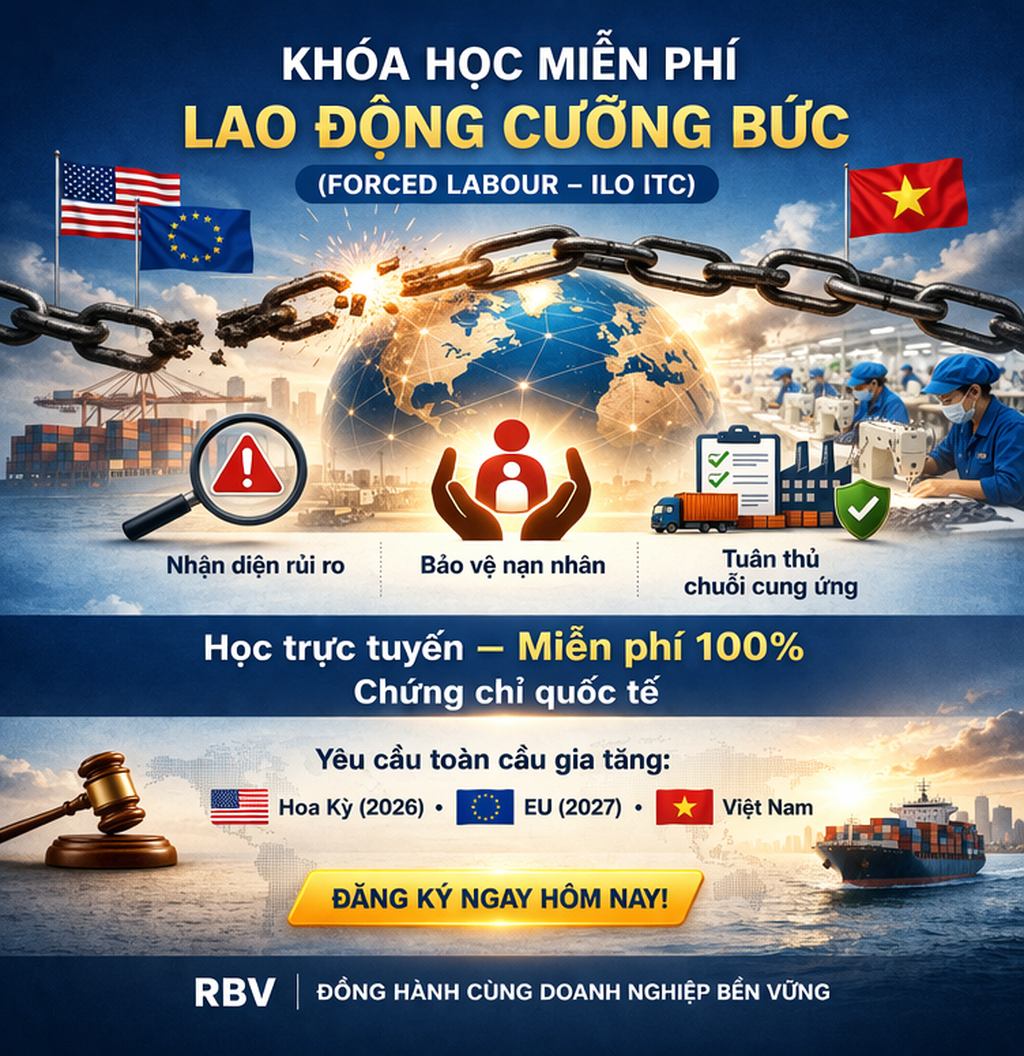
The International Training Centre of the ILO (ILO ITC) offers a free e-learning course on Forced Labour. This is a self-paced online course, designed to help participants gain in-depth knowledge and apply it in business operations and supply chains.
What will you learn? The course is structured around awareness – identification – action, covering:
1. Understanding Forced Labour
- Learn the ILO definition of forced labour
- Differentiate from related concepts such as: human trafficking; debt bondage; and modern slavery
2. Identifying Signs and Risks
- Key indicators and warning signs of forced labour
- How to detect risks in factories, suppliers and multi-tier supply chains.